
 Often external events, such as a downturn in the economy or rising unemployment, affect an entity’s revenue and ability to deliver on its mandate, while regulatory changes may result in the transfer or cession of some or all of an entity’s functions.
When preparing financial statements, management is required to assess the entity’s ability to continue as a going concern. This is because GRAP 1 on Presentation of Financial Statements requires that financial statements are prepared on a going concern basis unless there is an intention to liquidate the entity, to cease its operations, or if there is no realistic alternative but to do so. GRAP 1 also requires management to assess if material uncertainties exist that may cast significant doubt on the entity’s ability to continue as a going concern. The assessment of going concern and material uncertainties, which are two separate assessments, needs to be made at the reporting date.
New amendments to GRAP 1, effective for periods commencing on or after 1 April 2027, now further clarify these assessments and introduce new disclosure requirements to provide users with the information they need.
New clarifications in GRAP 1
The new requirements in GRAP 1 clarify that preparing financial statements on a going concern basis is inappropriate when an entity will be liquidated, all its operations will cease, or when there is no realistic alternative but to do so. However, preparing financial statements on the going concern basis remains appropriate when functions are transferred, or two or more entities merge. This is because the functions previously provided will continue, only in a different form or through another entity.
New disclosure requirements
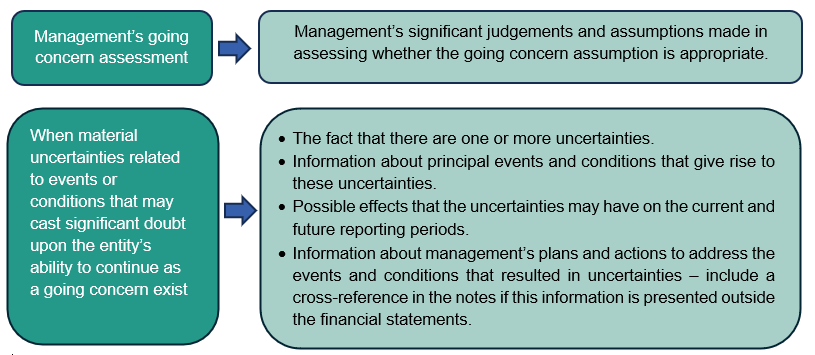
The material uncertainties noted by management may in future impact the entity’s going concern, resulting in an intention to liquidate the entity, to cease its operations, or when there is no realistic alternative but to do so.
The GRAP 1 Fact Sheets on Assessing Going Concern and Preparing Financial Statements on a Basis Other than Going Concern are useful tools in understanding the application of going concern. Also have a look out for a new flowchart that will provide useful information on assessing going concern and material uncertainties.
Disclaimer
The article has been prepared by the Secretariat of the ASB for information purposes only. It has not been reviewed, approved, or otherwise acted on by the Board.