
Identifying roles in a principal-agent arrangement – who is acting on behalf of who?
- May 15, 2023
- Posted by: Julianne Vissie
- Category: Blog
The Accounting Standards Board is conducting its post-implementation review of GRAP 109 Accounting by Principals and Agents. ED 200 is available on the ASB website with a comment deadline of 15 September 2023.
A series of previous articles explained what principal-agent arrangements are for financial reporting purposes.

How does an entity determine its role?
The rights and obligations established for the various parties inform an entity’s assessment of whether it undertakes transactions for its own benefit (i.e. it is the principal), or for the benefit of another entity (i.e. it is the agent). These rights and obligations are set out in the binding arrangement.
What does an entity consider to determine its role?
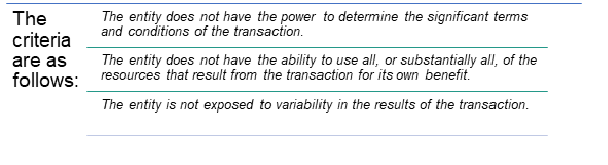
GRAP 109 paragraph .25 provides three criteria that an entity applies to assess if it is the agent. All three of the criteria need to be present for an entity to be an agent. If all the criteria are not present, the entity is by default the principal.
Substance over form
A previous article on Identifying principal-agent arrangements – the meaning of substance over form explained what substance over form means and how it should be applied when identifying principal-agent arrangements. The principle of substance over form also applies when entities assess their roles in a principal-agent arrangement.
This means that an entity applies the criteria in GRAP 109 to assess if it is the agent. The entity does not consider any legal title or role that it may have been assigned in legislation or the binding arrangement. For example, a principal-agent binding arrangement may attribute the terms “agent” or “implementing agent” to Entity X and “principal” to Entity Y respectively. Both entities assess their roles by applying the criteria in GRAP 109 for financial reporting purposes.
The criteria in GRAP 109.25 do not…
… Indicate whether an arrangement is a principal-agent arrangement.
The criteria in GRAP 109.25 should not be considered as part of the assessment of whether an arrangement is a principal-agent arrangement. The criteria are only applied to arrangements that meet the definition of a principal-agent arrangement, for the purpose of identifying whether an entity is an agent in the arrangement.
Comment to the Board on ED 200
The Board welcomes comment from all stakeholders on any aspect of GRAP 109.
Comment may be provided in writing through questionnaires (available on the ED 200 webpage on the ASB website) or in any other written format to info@asb.co.za. Comment may also be provided through roundtable discussions. Contact elizna@asb.co.za to be invited to a roundtable discussion.
Disclaimer
The article has been prepared by the Secretariat of the ASB for information purposesonly. It has not been reviewed, approved, or otherwise acted on by the Board.