
IPSASB Exposure Draft on Revenue with Performance Obligations (ED 181)
- April 6, 2020
- Posted by: Julianne Vissie
- Category: Uncategorized
What is revenue from a binding arrangement?
The IPSASB issued three Exposure Drafts in February 2020 on Revenue with Performance Obligations (ED 181), Revenue without Performance Obligations (ED 182) and Transfer Expenses (ED 183).
ED 181 is aligned with IFRS 15 on Revenue from Contracts with Customers and expands the principles to deal with public sector specific issues. For example, instead of only dealing with transactions from contracts with customers like IFRS 15, the ED includes transactions from binding arrangements. This was deemed necessary because:
- some jurisdictions are unable to enter into contracts in their own name and therefore transact based on other types of arrangements; and
- performance obligations may arise from arrangements other than contracts in the public sector.
What is a binding arrangement?
The ED is underpinned by the definition of a binding arrangement as it determines the scope of transactions included in the ED.
ED 181 defines a binding arrangement as “an arrangement that confers both enforceable rights and obligations on both parties to the arrangement”. A contract is seen as a type of binding arrangement and is defined in ED 181 as “an agreement between two or more parties that creates enforceable rights and obligations”. Binding arrangements can also be evidenced by legislative or other statutory mechanisms known as “secondary legislation”, that arise from legislative or executive authority and include cabinet or ministerial directives. The definition of a binding arrangement is used with the same meaning in ED 182 and ED 183.
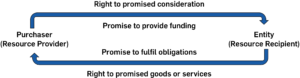
The ED’s definition means all the following must be present for an arrangement to be a binding arrangement:
- The purchaser (resource provider) promises to pay another party (resource recipient).
- In return for the payment, the purchaser (resource provider) has a right to receive the goods or services specified in the arrangement.
- The other party (resource recipient) promises to deliver specified goods or services to the purchaser or to a third party beneficiary.
- In return for delivering the specified goods or services, the other party (resource recipient) has a right to receive payment.
The above is demonstrated in the ED with the following diagram:
Although this definition is used with the same meaning in ED 182 and ED 183, it does not have the same meaning in other IPSASs. For example, IPSAS 35 on Consolidated Financial Statements defines a binding arrangement as “an arrangement that confers enforceable rights and obligations on the parties to it as if it were in the form of a contract. It includes rights from contracts or other legal rights.”
The difference is that in IPSAS 35, it is not necessary for both parties to have both rights and obligations. Therefore, a binding arrangement could be an arrangement where one party has rights and another party has obligations.
What are the accounting implications of the definition of a binding arrangement?
Because the definition of a binding arrangement in ED 181 to ED 183 requires both parties to have rights and both parties to have obligations, arrangements where one party has rights and another party has obligations would not be seen as a binding arrangement, even if the arrangement is a contract or arises from legislation or similar means. For example, taxes, bequests, fines and donations are transactions without binding arrangements as defined in ED 181 to ED 183. Only revenue transactions from binding arrangements are in the scope of ED 181. Therefore, all revenue transactions without a binding arrangement are in the scope of ED 182.
IFRS 15 applies to transactions from contracts with customers and accounts for revenue using a performance obligation approach. ED 181 broadened the IFRS 15 approach to apply to binding arrangements and uses a public sector performance obligation approach (PSPOA). The PSPOA is based on the five-step approach in IFRS 15, modified for the public sector. The result is that in ED 181, transactions that arise from mechanisms other than contracts are accounted for using the PSPOA while the model was designed in IFRS for transactions from contracts.
How is the definition of a binding arrangement different in Standards of GRAP?
The ASB has standardised the definition of a binding arrangement across Standards of GRAP to be the same as the definition used in IPSAS 35. Therefore, in Standards of GRAP, it is not necessary for both parties to have rights and both parties to have obligations from an arrangement for it to be a binding arrangement.
Similar to IPSAS, binding arrangements in Standards of GRAP may take many forms, such as a legal contract or other statutory mechanisms, for example, municipal by-laws, ministerial orders and cabinet or municipal council decisions.
Because ED 181 only includes transactions from a binding arrangement as defined in the ED, the scoping of transactions between ED 181 and ED 182 may be different if the GRAP definition is applied. In Standards of GRAP, more transactions would be in the scope of ED 181 than in IPSAS.
Given the potential implications of adopting the definition of binding arrangement proposed by the IPSASB, this would need to be discussed with stakeholders during the consultation process.
Where can the EDs be accessed and how can you provide comment?
The EDs have been published on the ASB’s website and can be accessed here: https://www.asb.co.za/comment-on-proposals/. Comment can be submitted to the Secretariat of the ASB at info@asb.co.za.