
IPSASB Exposure Draft on Revenue with Performance Obligations (ED181) part 2
- April 20, 2020
- Posted by: Julianne
- Category: Blog
A performance obligation approach to recognising revenue and expenses
As entities in the public sector often transact with one another, the IPSASB decided it’s important for both parties to a transaction to account for the transaction using consistent principles. For example, if one level of government is paying money to another level of government, the accounting principles applied for revenue and expenses should be consistent.
What has the IPSASB considered in developing a new revenue recognition approach, and what have they decided?
The IPSASB consulted on the accounting for revenue and non-exchange expenses in 2017, driven by the need to align IPSAS 9 on Revenue from Exchange Transactions and IPSAS 11 on Construction Contracts to IFRS 15 on Revenue from Contracts with Customers. IFRS 15 recognises revenue based on the satisfaction of performance obligations, as defined in IFRS 15.
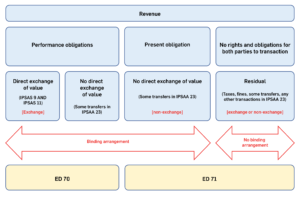
Based on feedback received, the IPSASB decided to revise IPSAS 9 and IPSAS 11 to outline accounting requirements for “transactions with performance obligations”. IPSAS 23 on Revenue from Non-exchange Transactions (Taxes and Transfers) would be retained and updated to deal with “transactions without performance obligations”. The change in approach means that transactions from a revenue perspective are no longer defined as “exchange” or “non-exchange”, but rather as transactions “with performance obligations” or “without performance obligations”. This change towards the recognition of revenue based on the satisfaction of performance obligations is called the “public sector performance obligation approach”. Two Exposure Drafts have been issued for revenue:
- ED 181 on Revenue with Performance Obligations.
- ED 182 on Revenue without Performance Obligations.
Diagram 1 illustrates the current exchange / non-exchange revenue recognition model compared to the proposed PSPOA model.
Diagram 1: Current compared to proposed revenue recognition models
How does the new revenue recognition approach apply to expenses?
Given the need to apply consistent principles for revenue and expense transactions, the IPSASB issued ED 183 on Transfer Expenses to explain the application of the PSPOA to the last remaining area where guidance was needed, i.e. non-exchange expenses. Given the use of the PSPOA in ED 72, there are strong links with the principles in ED 181 and ED 182.
Diagram 2 illustrates the interaction of the three Exposure Drafts.
Diagram 2: Interaction of ED 181 to ED 183.

What are the potential implications locally?
The Standards of GRAP dealing with revenue transactions are aligned to the existing IPSAS, being:
- GRAP 9 on Revenue from Exchange Transactions
- GRAP 11 on Construction Contracts
- GRAP 23 on Revenue from Non-exchange Transactions (Taxes and Transfers)
The Board would need to consider whether to align with any new or revised IPSAS that are issued. Because there is no existing Standard of GRAP on transfer expenses, the Board would consider whether this should be issued as a Standard of GRAP.
Where can the EDs be accessed and how can you provide comment?
The EDs have been published on the ASB’s website and can be accessed here: https://www.asb.co.za/comment-on-proposals/. Comment can be submitted to the Secretariat of the ASB at info@asb.co.za.