
IPSASB proposes accounting requirements for government expenses
- June 2, 2020
- Posted by: Julianne
- Category: Blog
No guidance on government expenses
Governments exist primarily to provide services to its citizens and others. These services take many forms and include providing services for all to access, as well as direct support to individuals in the form of goods, services and financial support.
The International Public Sector Accounting Standards Board (IPSASB) sets requirements for governments around the world to use when preparing their financial statements. Up until 2019, there was a lack of guidance internationally on how to account for expenditure incurred by governments to provide such services to citizens and others. This means that governments – and their entities – could have applied widespread accounting practices in deciding when, and at what value, to recognise these expenses and any corresponding liability.
The IPSASB issued ED 72 on Transfer Expenses for comment. ED 72 is one component of a larger reform dealing with accounting for expenses. As the ASB primarily uses IPSAS in developing Standards of GRAP, it is exploring and discussing the proposed approach in ED 72 and how feasible it is to apply locally. Issues identified locally on ED 72 will be shared with the IPSASB.
Classification of government expenses
Historically, when debating the accounting for government expenditure there have been two broad categories – expenses where government gives consideration and receives approximately equal value in return (“exchange expenses”), and those where consideration is given, but either the value received is not approximately equal to the consideration given, or there is no direct exchange of value between the parties (“non-exchange expenses”). The following are examples:
The categorisation of government expenses to date has also been driven by statistical reporting – specifically the Government Finance Statistics Manual (GFSM) issued by the International Monetary Fund. Government statistics aim, in part, to measure who benefits from government expenditure. As a result, identifying the beneficiary, e.g. an individual, household, or another entity is important.
As the accounting for expenses has been deliberated by the IPSASB, the broad categorisation of expenses as exchange or non-exchange has evolved. One of the key issues that may need to be considered is whether expenses will continue to be classified broadly into exchange or non-exchange, or whether another distinction will be used. For revenue transactions, there is a proposed change in focus from exchange or not, to whether transactions have performance obligations or not (see ED 70 on Revenue with Performance Obligations and ED 71 on Revenue Without Performance Obligations).
What are transfer expenses?
The IPSASB issued IPSAS 42 on Social Benefits in January 2019. This was the result of more than a decade long debate about (a) what social benefits are, and (b) when do they give rise to liabilities for governments. Prior to the issue of IPSAS 42, any benefits provided to individuals and households – whether in cash or in-kind – were broadly categorised as “social benefits”. As the accounting evolved, the IPSASB made a clear distinction between those benefits that are provided in cash or in-kind, who they were provided to, and for what purpose.
Diagram 1 outlines an overview of the types of government expenses identified for accounting purposes.
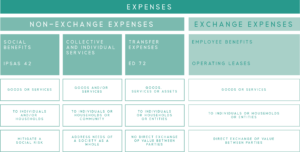
Diagram 1 – Overview of expenses
In summary, “non-exchange expenses” can be analysed into the following categories:
ED 72 only deals with transfer expenses. Typical examples in the local environment include:
ED 72 proposes two approaches for accounting for transfer expenses. These approaches will be explored in articles throughout June.
Where can the EDs be accessed and how can you provide comment?
ED 72 was issued for comment along with proposed IPSAS on changes to revenue recognition. ED 72, along with the Exposure Drafts on revenue have been published on the ASB’s website and can be accessed here: https://www.asb.co.za/comment-on-proposals/. The EDs are as follows:
Comment can be submitted to the Secretariat of the ASB at info@asb.co.za. The comment deadline is 1 October 2020.
The views expressed in this article are those of Secretariat and not the ASB Board.