
We are consulting on the IPSASB’s first Sustainability Reporting Standard! (part 2 of 3)
- January 27, 2025
- Posted by: Julianne Vissie
- Category: Blog
Part 1 of this article dealt with the conceptual foundations and general requirements proposed in the IPSASB’s Exposure Draft (ED) on Climate-related Disclosures.
The IPSASB asserts that the ED provides useful information for primary users of general purpose financial reports about:
- climate-related risks and opportunities to an entity’s own operations. This guidance is adapted from private sector guidance, primarily IFRS S2 Climate-related Disclosures and the Taskforce for Climate-related Disclosures; and
- climate-related public policy programmes and their outcomes. These requirements integrate the Global Reporting Initiative’s multi-stakeholder focus.
This article focusses on point A above, i.e. disclosure on climate-related risks and opportunities to an entity’s own operations.
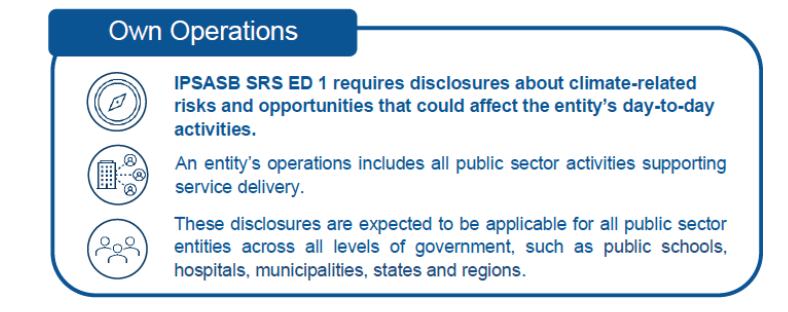
Source: IPSASB SRS ED 1 At a Glance
Public sector entities’ operations may be affected by climate-related risks – such as those resulting from severe weather events, and opportunities – such as the transition to low-carbon technologies. The ED proposes disclosure requirements about these climate-related risks and opportunities that affect the entity’s ability to continue to deliver on its mandate. The four pillars for reporting on an entity’s own operations include an entity’s governance, strategy, risk management and its metrics and targets, as follows.

Source: IPSASB SRS ED 1 At a Glance
Submit your written comment or questions on ED 213 to info@asb.co.za or participate in scheduled consultations. Details of these consultations are shared on the “ASB Engage” post on Fridays. Comment from stakeholders will be considered for inclusion in the ASB’s comment letter to the IPSASB. The comment period closes on 14 February 2025.